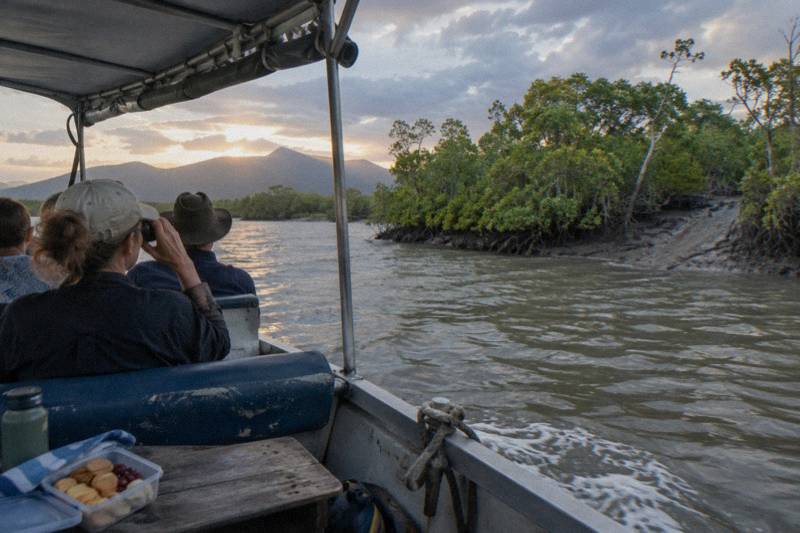
Crocodile Spotting On An Evening Cruise Out Of Port Douglas
Crocodiles live in Dickson Inlet, the tidal river system that Port Douglas sits beside, and one calm-water boat runs a scheduled sunset cruise several kilometres up its mangrove channels. Here is how that trip works, what a sighting actually depends on, and the safety rules that govern sharing the water with an animal that grows over four metres.
Short answer
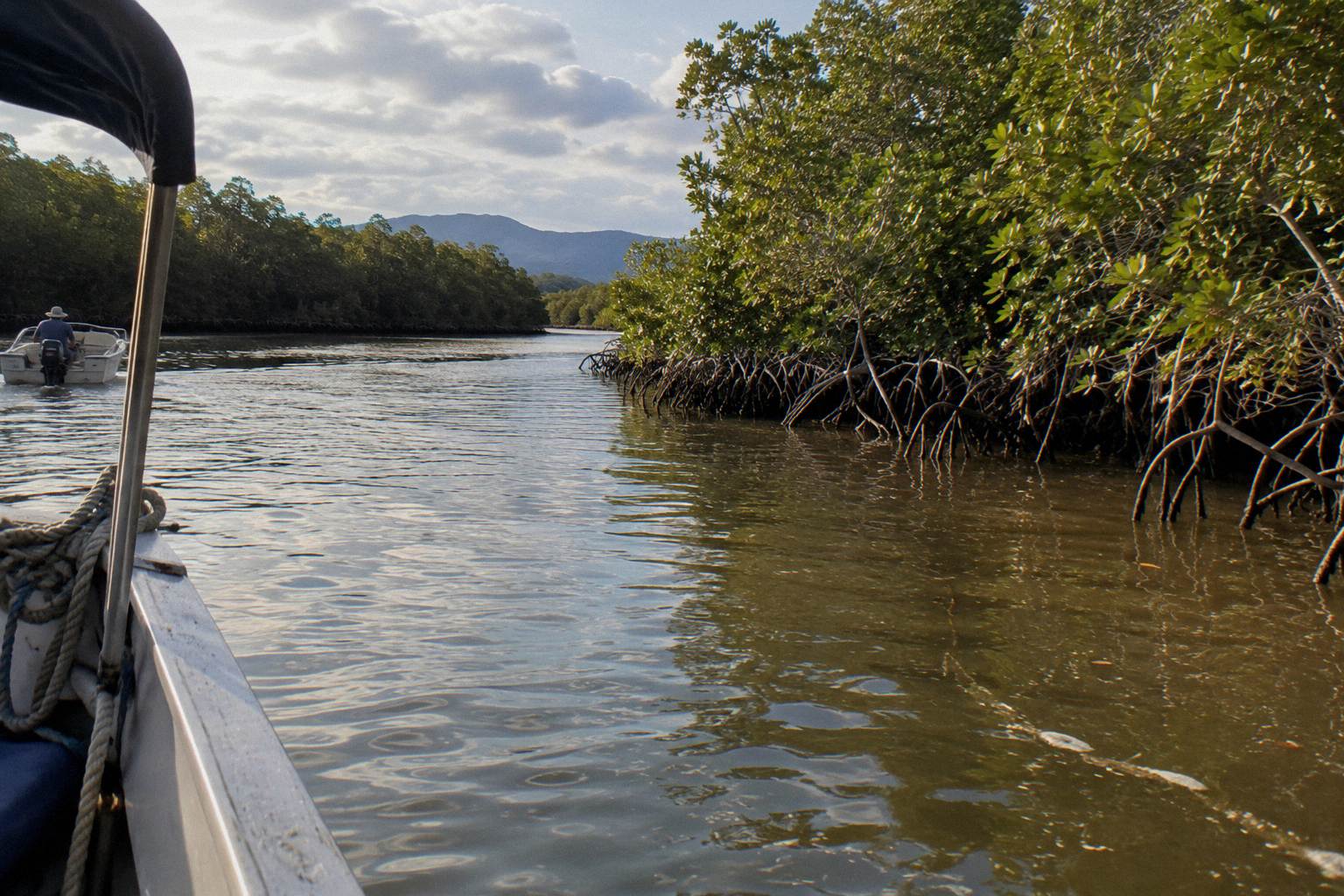
The Lady Douglas sunset cruise runs 4:30pm to 6:00pm, from A$48 per person, from Crystalbrook Superyacht Marina up the Dickson Inlet mangrove channels. The operator says crocodiles are normally seen on over 90 percent of its trips, especially May to November. It is an operator claim, never a guarantee: crocodiles can stay submerged for hours and no waterway in their range is crocodile free.
Crocodiles are the reason many travellers first look twice at a map of Port Douglas. The town sits on a headland between the Coral Sea and Dickson Inlet, a tidal river system of mangrove channels that estuarine crocodiles inhabit, and Queensland Government range maps put the whole area inside crocodile habitat, which starts near Gladstone and runs north to the Torres Strait. One calm-water boat, the Lady Douglas, runs a scheduled sunset cruise into those channels with commentary on mangroves, crocodiles and local history. The operator says crocodiles are normally seen on over 90 percent of its trips, especially in the dry season from May to November, and that single hedged claim is the only sighting figure anywhere in the picture.
What follows is a plain account of how the trip works: the route, the times, the price in Australian dollars, the birds that share the inlet, the government safety advice that matters on any boat in this water, and how the evening river option compares with the open-water sunset sails that leave the same marina. Crocodiles are wild animals that can stay underwater and out of sight for hours, so nothing here promises a sighting, and nothing should.
What Is A Crocodile Cruise Out Of Port Douglas?
A crocodile cruise out of Port Douglas is a 1.5 hour calm-water river trip through the mangrove channels of Dickson Inlet, run by Lady Douglas from Crystalbrook Superyacht Marina at 44 Wharf Street, with commentary on mangroves, crocodiles and local history. The sunset departure runs 4:30pm to 6:00pm and costs from A$48 per person, including one complimentary beverage and a snack box.
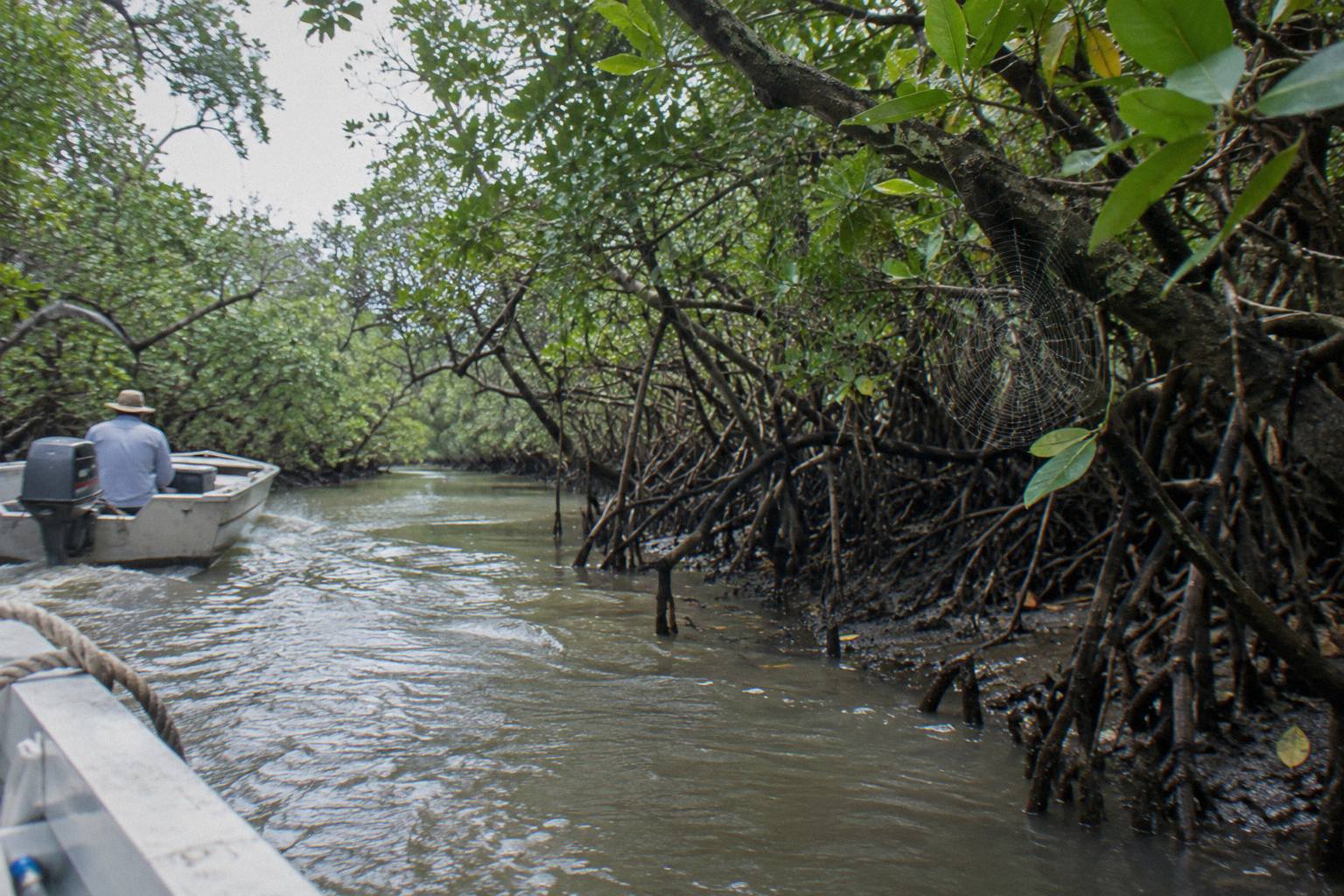
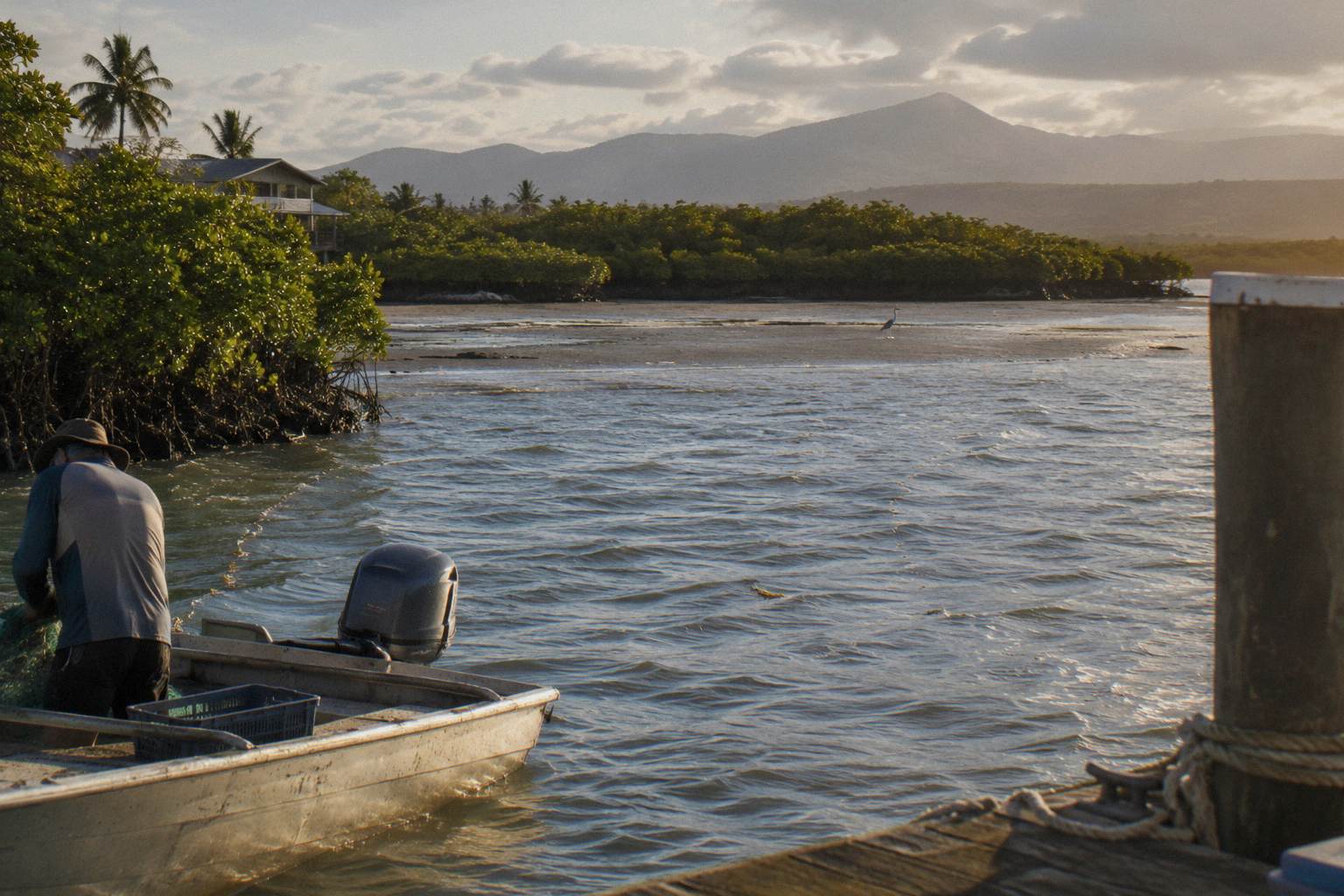
The boat travels through the waterfront and harbour, several kilometres up the mangrove channels of Dickson Inlet, and out to the inlet entrance. Dickson Inlet is a working tidal system, not a theme park waterway: the Port of Port Douglas is a small natural harbour behind Island Point within the inlet's border, and the channels beyond it wind through mangroves that the commentary explains in detail, along with the crocodiles that live there and the local history of the port. The vessel is a calm-water boat with covered seating over the entire back deck and a toilet on board, which matters for families and for anyone who wants shelter from a passing shower.
Four scheduled cruises a day run on the route: morning 10:30 to 12:00, midday 12:30 to 14:00, afternoon 14:30 to 16:00 and sunset 16:30 to 18:00. The operator says cruise times depend on seasonal demand, so check the calendar for the day you want. The sunset departure is the one that pairs crocodile spotting with the end of the day, and it is the departure most visitors choose for that reason. If you are weighing a river trip against time on the water in daylight, the day or evening river cruise comparison breaks down which departure suits which kind of group.
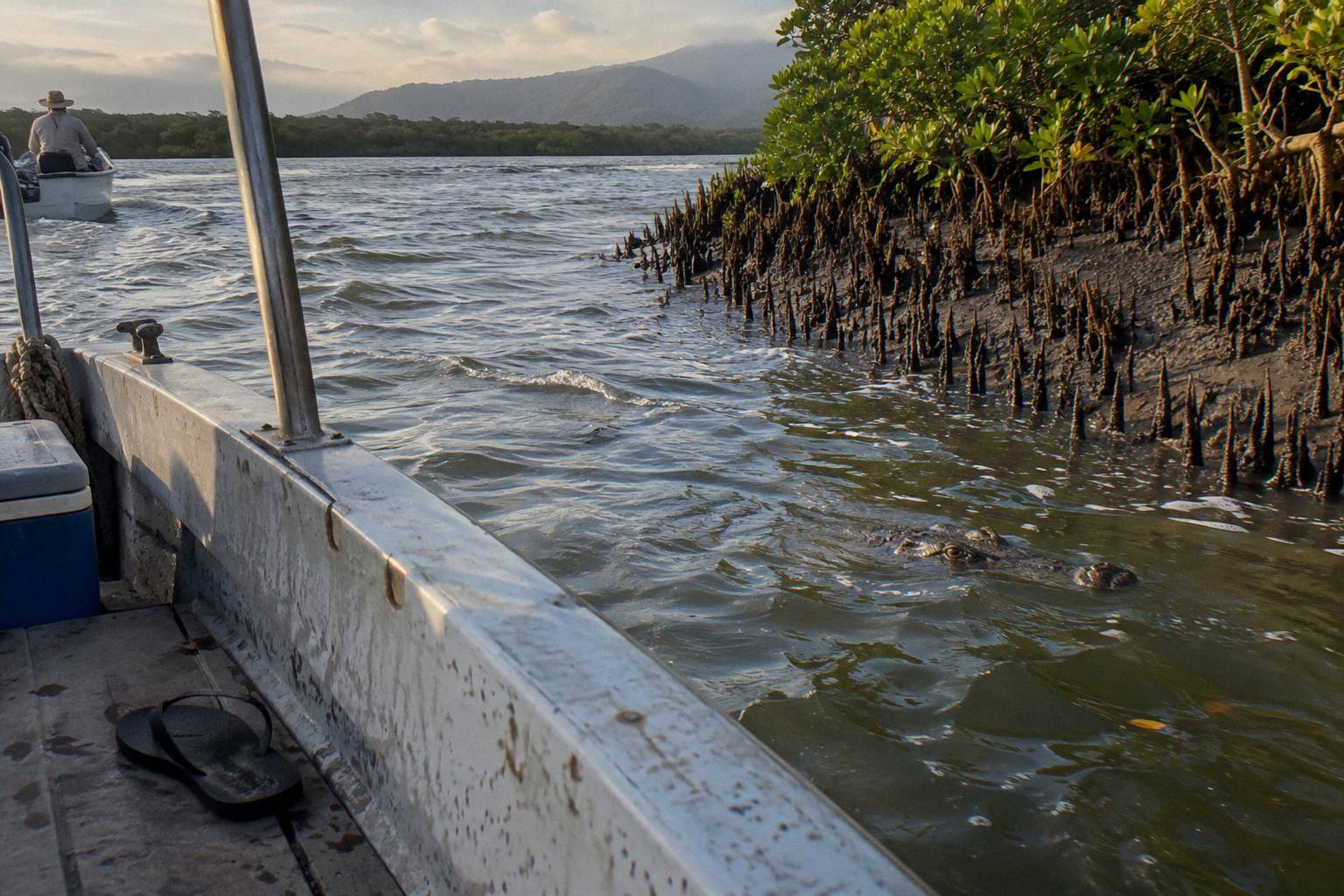
A companion piece worth reading first answers the basic question straight: will you see crocodiles on a Dickson Inlet evening cruise. The short version is that sightings are common, the operator's own figure is the 90 percent claim above, and no crocodile anywhere in Queensland performs on schedule.
Where The Crocodiles Around Port Douglas Actually Live
Estuarine crocodiles inhabit Dickson Inlet and every other waterway around Port Douglas, because Queensland Government range advice puts crocodile habitat from near Gladstone north to the Torres Strait, and states plainly that no waterway in that range is crocodile free. They can stay underwater, out of sight, for hours, and the absence of a warning sign means nothing. The inlet is crocodile habitat, full stop.
The Queensland Government's Be Crocwise advice is the reference point for any conversation about crocodiles in this region, and its wording deserves reading in full on the official Be Crocwise page. Three of its points matter most for a boat passenger. First, estuarine crocodiles can be found in any waterways and the sea throughout the range, not only in remote rivers. Second, they can stay submerged and invisible for hours, which is why an evening cruise can pass a bank where a four metre animal rested the day before and see only water. Third, the absence of a sign does not mean there are no crocodiles.
| Be Crocwise point | What it means on the water |
|---|---|
| Habitat runs from near Gladstone to the Torres Strait | Dickson Inlet and the seas off Port Douglas sit inside the range |
| Crocodiles can stay underwater, out of sight, for hours | A clear channel today says nothing about tomorrow |
| No sign does not mean no crocodiles | Do not treat unmarked water as safe water |
| Estuarine crocodiles grow over 4 metres | Adult animals in this region are large predators |
| Nesting is December to April; September to April is the breeding season | Crocodiles can be more active and defensive in those months |
The same government advice covers how to behave from a boat: keep arms and legs inside the vessel, avoid kayaks, paddleboards and other small craft in crocodile waters, and never bring a boat within 10 metres of a crocodile. The Lady Douglas cruise operates within that framework on every departure, and the boating tips page is worth a read before any trip on North Queensland water, chartered or scheduled. Dickson Inlet is never described as safe to swim or paddle, and no cruise in Port Douglas will suggest otherwise.
For the evening itself, three boats out of the same marina give you a real choice of water: the river cruise into the mangroves, a sailing catamaran out on the Coral Sea, and a Chinese junk that does both inlet and open water on its route.
The Lady Douglas Sunset Cruise: Times, Price And What Is Included
The Lady Douglas sunset cruise runs 4:30pm to 6:00pm for 1.5 hours, from A$48 per person, boarding at Crystalbrook Superyacht Marina on Wharf Street. It includes one complimentary beverage from the bar and a box of snacks, all ages are welcome, and the boat carries a rating of 4.6 from 571 reviews. Free cancellation applies up to 24 hours before the start.
The sunset departure is one of four daily cruises, and the operator says times depend on seasonal demand, so the calendar for your date is the authority on the exact start. Aboard, the covered back deck seats everyone out of the weather, a toilet is on board, and the commentary runs through mangroves, crocodiles and local history as the boat moves several kilometres up the channels to the inlet entrance. Infant seats are available and infants sit on laps, and activity colouring sheets are there for children, which makes the trip one of the few evening boats in Port Douglas that genuinely works for a family with small kids.
The 4.6 rating from 571 reviews is a large pool for a town this size,. Much of the route runs up the mangrove channels of Dickson Inlet rather than on open water, which is precisely the point of choosing it. For a fuller account of the boat and its route, see the Lady Douglas evening cruise on Dickson Inlet.
| Detail | Lady Douglas sunset cruise |
|---|---|
| Departure and return | 4:30pm to 6:00pm, 1.5 hours |
| Price | From A$48 per person |
| Included | One complimentary beverage and a snack box |
| Ages | All ages, infant seats available, infants on laps |
| Boarding | Crystalbrook Superyacht Marina, 44 Wharf Street |
| Cancellation | Free up to 24 hours before the start |
| Rating | 4.6 from 571 reviews |
One practical note on getting there: the marina is at 44 Wharf Street, and regulated council car parks nearby include the Wharf Street car park and the Port Douglas Harbour car park. Signs at each car park decide the terms, and no marina parking fee or time limit is published. Arrive with time to find a spot and walk to the berth, and if you are coming from Cairns, read how to get to the marina for an evening boat first, because the last shared bus back south leaves before any sunset cruise finishes.
What You Actually See On The Inlet At Dusk
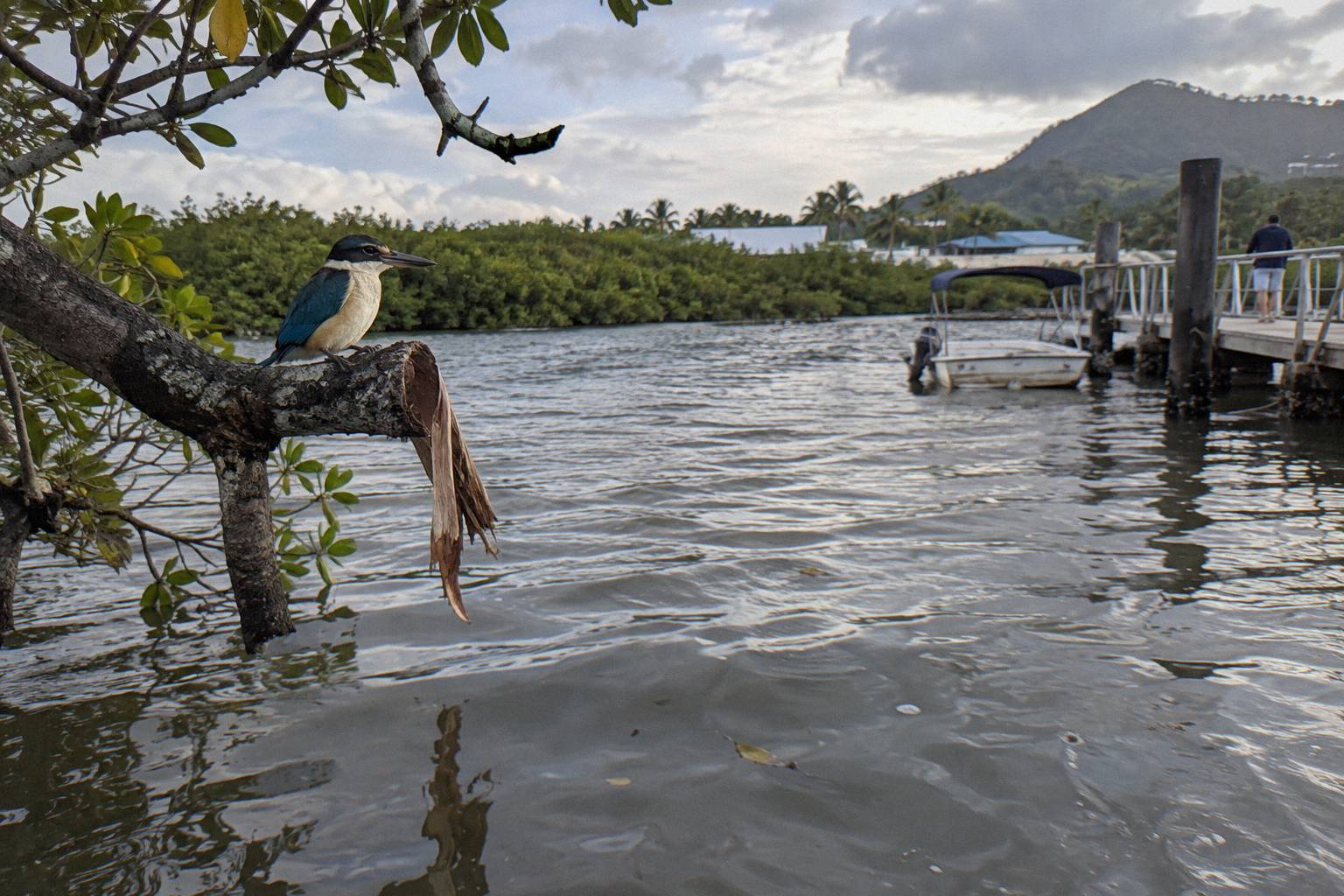
The wildlife list for the inlet is specific: brahminy kites, ospreys, white-bellied sea eagles, mangrove herons, whimbrels, rainbow bee-eaters, sunbirds and kingfishers, all named by the Lady Douglas operator, plus crocodiles on the hedged 90 percent claim. No whale, dolphin, turtle or dugong claim exists for any Port Douglas trip, so expect birds, mangroves and crocodiles, and treat anything beyond that as a bonus.
The birdlife is the quiet strength of a mangrove cruise. Kingfishers and rainbow bee-eaters are the flashes of colour in the branches, brahminy kites and white-bellied sea eagles work the channel overhead, and mangrove herons and whimbrels hold the shallows. The commentary ties it together with the ecology of the mangroves themselves and the history of the port, so the trip is a natural history outing rather than a single-species hunt. That matters if you are travelling with someone who is lukewarm on crocodiles: they get the landscape, the birds and an hour and a half of calm water.
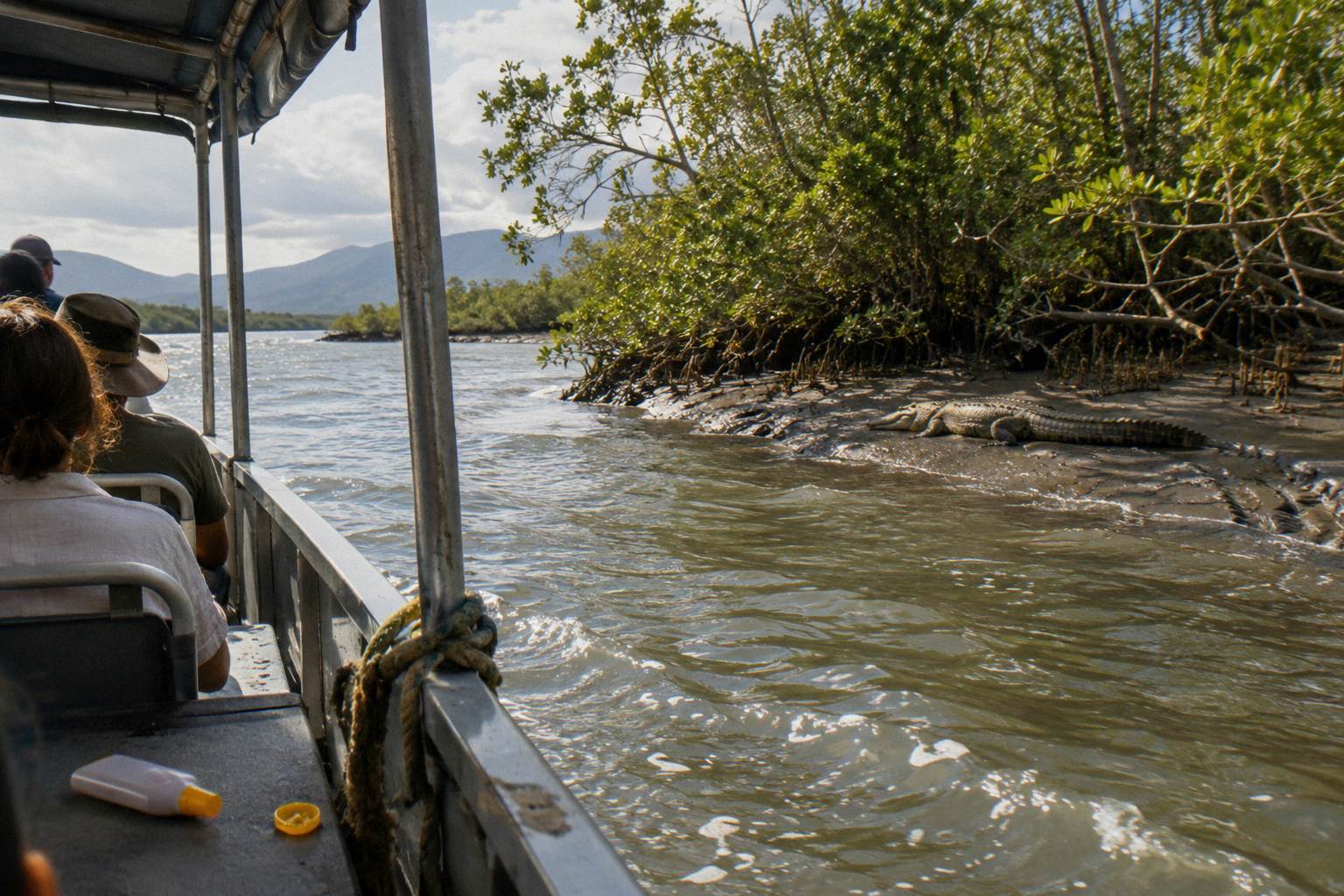
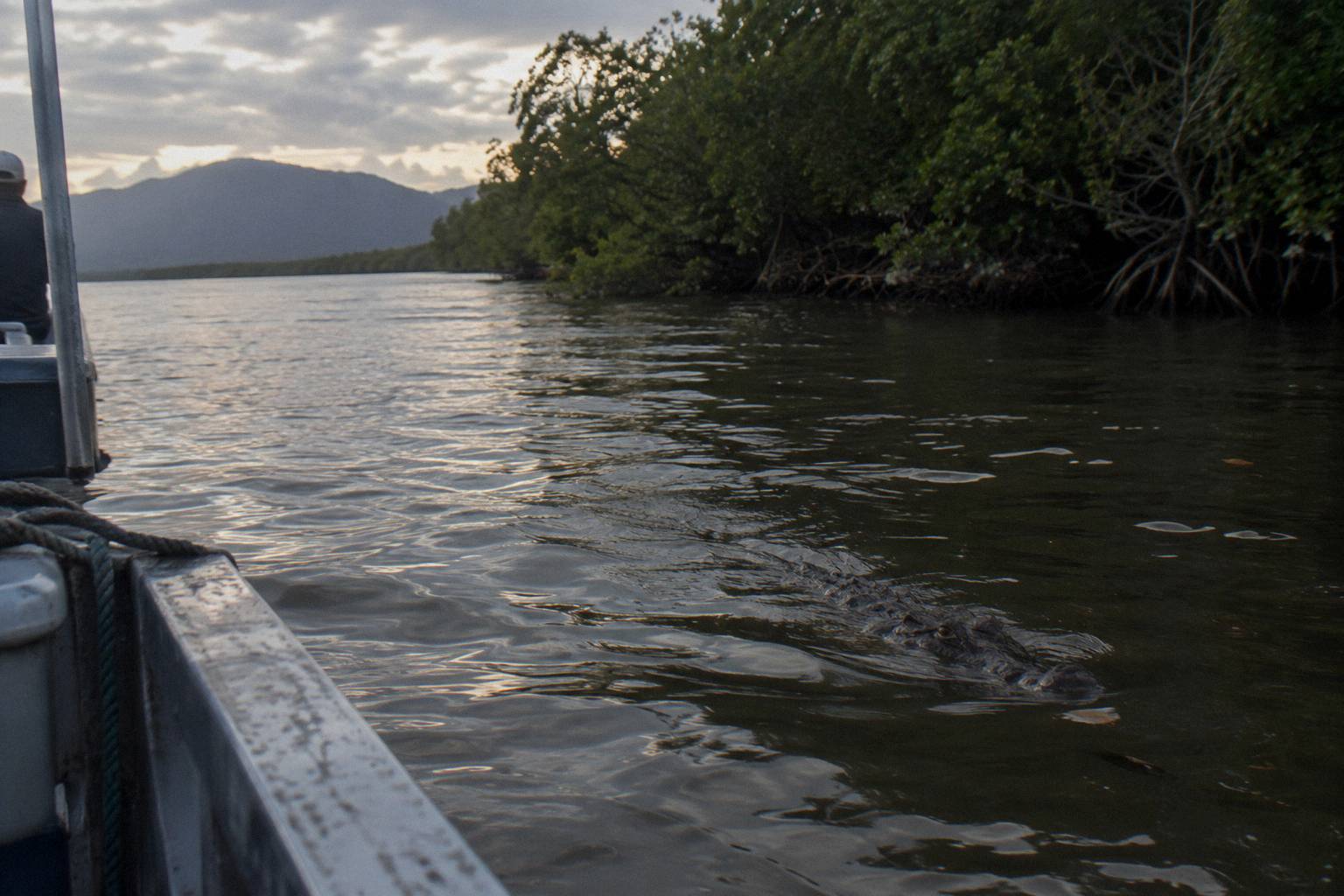
Crocodiles, when they appear, are usually seen as eyes and snout wake in the channel or as a body hauled out on a warm bank, and dusk is a sensible time to be looking because the heat of the day has passed. The estuarine crocodile is most common in the tidal reaches of rivers, which is exactly the water the cruise travels. But the government's point about submersion cuts both ways: an animal that can vanish for hours can also be five metres from the boat and invisible. Take the operator's 90 percent figure as what it is, a statement from the company that runs the trips, and enjoy whatever the evening delivers.
The Best Months For Crocodile Spotting
The dry season from May to November is when the Lady Douglas operator says crocodile sightings are most reliable, and its hedged claim points at exactly that window. Bureau of Meteorology data backs the logic: July to September average just 23 to 32 mm of rain and 4 to 5 rain days, while January to March each average over 395 mm. Cooler, drier months bring crocodiles out to bask; heavy wet season rain hides them.
The climate record for Port Douglas, from the Bureau of Meteorology's Warner Street station and its long-term averages table, shows a town with two distinct halves of a year. Mean maximums sit at 30.3 °C in January and 24.6 °C in July, and rainfall divides sharply: the three wettest months carry more than 395 mm each, the three driest carry well under 50 mm each. For a crocodile trip, the practical difference is warmth and visibility. A dry season evening at 25 to 27 °C is comfortable on the covered deck, and crocodiles basking on banks in the cooler months are easier to spot than animals tucked into flooded mangroves in February.
| Month | Mean max (C) | Mean rain (mm) | Rain days (1 mm+) | Sunset, about |
|---|---|---|---|---|
| January | 30.3 | 395.8 | 13.8 | 6:57pm |
| February | 30.1 | 422.0 | 14.2 | 6:52pm |
| March | 29.5 | 429.4 | 14.4 | 6:34pm |
| April | 28.3 | 203.3 | 11.2 | 6:11pm |
| May | 26.7 | 72.8 | 8.0 | 5:55pm |
| June | 25.1 | 47.7 | 5.7 | 5:53pm |
| July | 24.6 | 26.4 | 4.2 | 6:01pm |
| August | 25.3 | 23.3 | 4.0 | 6:09pm |
| September | 26.7 | 32.1 | 4.4 | 6:13pm |
| October | 28.3 | 53.1 | 5.3 | 6:17pm |
| November | 29.5 | 106.1 | 7.6 | 6:29pm |
| December | 30.3 | 213.5 | 10.1 | 6:46pm |
The sunset column is a calculation from NOAA solar formulas for the marina, not a boat time, and it explains why the 4:30pm departure lands where it does. In June the sun is down by about 5:53pm, so the cruise finishes in the dark; in January it sets about 6:57pm, after the boat is back at the marina. Neither version is wrong, they are different evenings, and the month by month sunset times guide works through the whole year. If you are planning around the wet half of the year, the wet season sunset sails guide covers what rain actually does to an evening on the water.
Crocodile Safety Rules On Any Boat In This Water
The rules are short and absolute: keep arms and legs inside the boat, never bring a vessel within 10 metres of a crocodile, and avoid kayaks, paddleboards and small craft in crocodile habitat. The estuarine crocodile grows over 4 metres, and September to April is the breeding season, with nesting from December to April. A scheduled cruise with a local crew handles all of this for you.
Passengers on the Lady Douglas have little to do but sit back, because the skipper runs the channel and keeps the distance the government advice requires. The rules matter most for the hours around your cruise, not during it: Dickson Inlet is never safe to swim or paddle, the mangrove banks are not a place to wander at dusk, and standing on the marina boardwalk with a drink is as close to the water as anyone should get after dark. The government's crocodile pages, including the estuarine crocodile species page, are the reference for behaviour anywhere in the range.
Two points from that advice surprise people. The first is scale: an animal that grows over four metres is not a large lizard, it is a predator the length of a small car. The second is patience: a crocodile that can stay submerged for hours does not need to avoid you, it simply stops existing as far as your eyes are concerned. Both points push in the same direction, which is that the only sensible way to look for crocodiles in Dickson Inlet is from a covered boat with a crew that knows the channel, and the sensible way to behave near any waterway in North Queensland is with the assumption that something is in it.
How The River Cruise Compares With The Open-Water Sails
The Lady Douglas sunset cruise, from A$48, stays inside Dickson Inlet on calm water with crocodiles as the headline; the Sailaway catamaran, from A$105, takes up to 80 guests out onto the Coral Sea for canapes and a welcome drink; the Shaolin junk, from A$71, sails the inlet out to open water on a 1969 Hong Kong built vessel. Three boats, one marina, three genuinely different evenings.
The choice is really a choice of water. If crocodiles, mangroves and birds are the reason you are booking, the river cruise is the only one of the three that goes looking for them, and its covered deck and all-ages policy make it the easiest evening with children. If open water, mountain views and a drink on a net are the draw, the Sailaway Sunset Sail runs on the Lagoon catamarans Sailaway IV and Sailaway VI, 5:00pm to 6:30pm, with hot and cold canapes, a welcome drink of wine, sparkling wine, beer or soft drink, and a rating of 4.6 from 391 reviews. Full details are in the sunset sailing cruise on a luxury catamaran page, and you can check availability if that evening fits your dates.
The Shaolin occupies the middle ground: an authentic Chinese junk built in 1969 in Hong Kong as Gloria Maris, sailing from Crystalbrook Superyacht Marina daily 5pm to 6:30pm, from A$71, with yum cha style canapes and a beverage included and a bar on board. Its route runs along Dickson Inlet, past the waterfront and out into the Coral Sea, so you see the inlet and the coast in one trip, though it is a sail rather than a wildlife cruise. The operator offers a 10 percent discount for booking both Shaolin and Lady Douglas, which is the one concrete way to combine a crocodile evening with an open-water evening. The Shaolin junk sunset cruise page has the boarding details.
| Lady Douglas river cruise | Sailaway catamaran | Shaolin junk | |
|---|---|---|---|
| Price | From A$48 | From A$105 | From A$71 |
| Time | 4:30pm to 6:00pm | 5:00pm to 6:30pm | 5:00pm to 6:30pm |
| Water | Dickson Inlet channels | Coral Sea | Inlet and Coral Sea |
| Crocodiles | Commentary and the hedged 90 percent claim | Not the focus | Passing views only |
| Included | One beverage and a snack box | Canapes and a welcome drink | Yum cha canapes and a beverage |
| Ages | All ages | All ages | Children 2 and over, best for 4 and up |
| Rating | 4.6 from 571 reviews | 4.6 from 391 reviews | Ask when booking |
If the decision is really between food on the water and animals on the water, the sunset sail or dinner cruise comparison works through the trade-offs, including the plain fact that no plated dinner cruise runs out of Port Douglas at all. The sailings above are what exists, and each does its job well.
Family Logistics: Ages, Weather And What To Bring
Lady Douglas takes all ages, provides infant seats and colouring sheets, and runs a toilet and covered seating on board, which makes it the most small-child-friendly evening boat in town. Sailaway also takes all ages but bans prams and strollers. Shaolin suits children 4 and up best, with steep boarding stairs and little hand railing, and Indigo sets a minimum age of 10. Bring nothing special for the river cruise: everything is on board.
The contrasts between the boats are sharpest at the family end. The river cruise's calm water, covered deck, toilet and colouring sheets suit toddlers and grandparents alike, and infants sit on laps free of fuss. Shaolin is the opposite case: the operator itself says children 4 and up suit the vessel best because it is open with little hand railing, younger children are welcome if checked with the operator first, and parents are fully responsible. Indigo, the 12-guest luxury catamaran, is an adults-and-older-kids boat by rule, minimum age 10 on scheduled trips, with BYO drinks, fridges and glassware on board and a complimentary local cheese and dip platter; check the live price once when you look at dates, no fare is printed here.
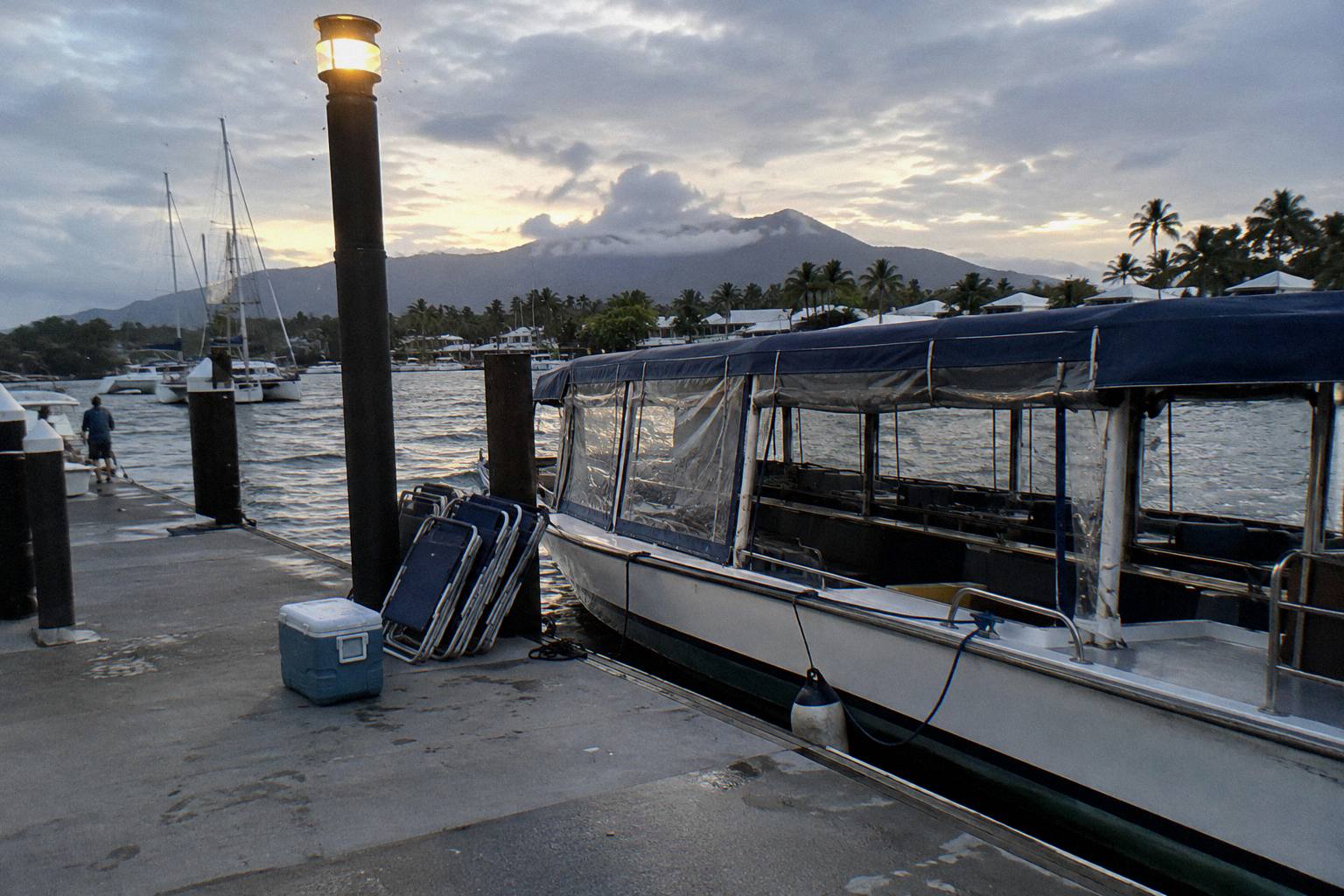
Weather shapes the evening more than packing does. The Lady Douglas has covered seating over the entire back deck, so a passing shower is an inconvenience rather than an ending, and showers are common from January to March. Shaolin reduces numbers on rainy days and hands out umbrellas, with about 12 to 15 sheltered saloon seats. Sailaway's terms are the strictest: if a guest chooses not to go in wind or rain when the vessel still operates, it counts as the guest's cancellation, and inside 24 hours that carries a 100 percent fee. No operator publishes a weather-cancellation guarantee, so ask the operator how it handles a cancelled departure if storms are forecast for your date. For packing generally, the what to pack for a sunset sail guide keeps it to what the operators themselves list.
Common Mistakes People Make Booking A Crocodile Cruise
The recurring mistakes: assuming a sighting is guaranteed, booking a Coral Sea sail and expecting crocodiles, staying in Cairns without checking the last bus, treating unmarked water as safe, and reading the 90 percent figure as a company promise rather than an operator claim. Each one is avoidable in a minute of planning, and each one shapes whether the evening feels like a success or a letdown.
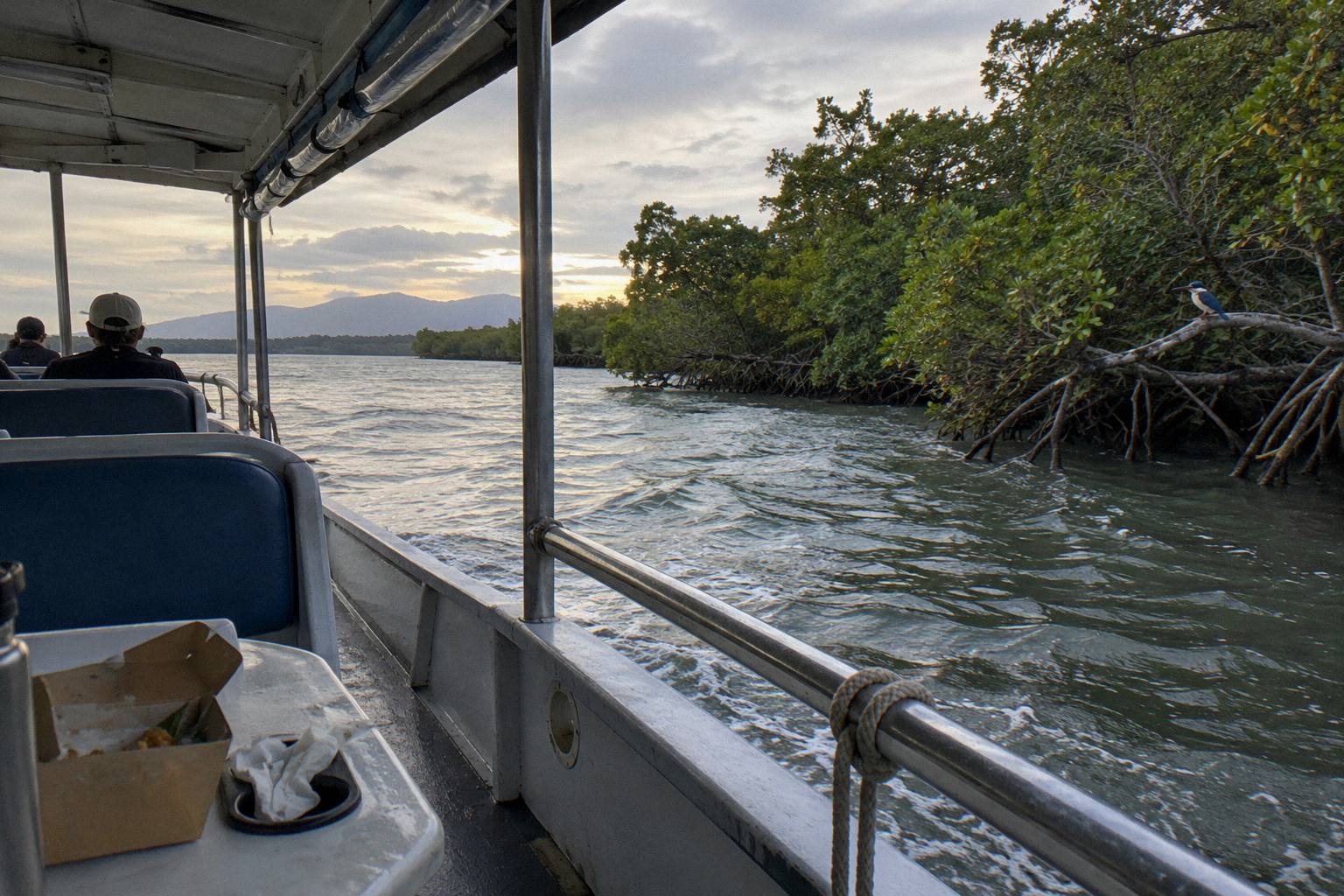
The first mistake is expectation. A crocodile that can stay submerged for hours does not check the manifest, and the operator's 90 percent figure is a statement from the company that runs the trips, hedged exactly as it should be. Book the cruise for the mangroves, the birds, the commentary and the chance of a crocodile, in that order of certainty, and the evening delivers. The second mistake is booking the wrong water: the sailing catamarans spend their 90 minutes on open sea, and no crocodile claim attaches to them. If crocodiles are the reason you are booking, the river cruise is the trip that goes where they live.
| Mistake | The fix |
|---|---|
| Expecting a crocodile on demand | Treat the 90 percent figure as an operator claim, not a promise |
| Booking an open-water sail for crocodiles | Choose the Dickson Inlet river cruise |
| Staying in Cairns with no late transfer | Stay in Port Douglas or pre-book an evening transfer |
| Wandering mangrove banks after the cruise | Keep to the marina; the inlet is never safe to swim or paddle |
| Assuming a sign means safety | No sign does not mean no crocodiles |
The transport mistake is the most expensive. The last shared bus from Port Douglas toward Cairns leaves around 5pm to 6pm, before any sunset cruise finishes, and no evening shuttle fare after 6:00pm is published. Stay in town for the night or book a late transfer in advance. The last mistake is behavioural: after a pleasant cruise, the inlet still contains exactly the animals you came to see, and the government advice about arms, legs, distances and small craft applies at the dock just as it did on the water. Enjoy the evening from the boardwalk.
If you want the full run of evening options before you commit, Port Douglas Sunset Cruises compares every boat that leaves the marina at the end of the day, and the how to choose an evening boat guide walks the decision by group type.
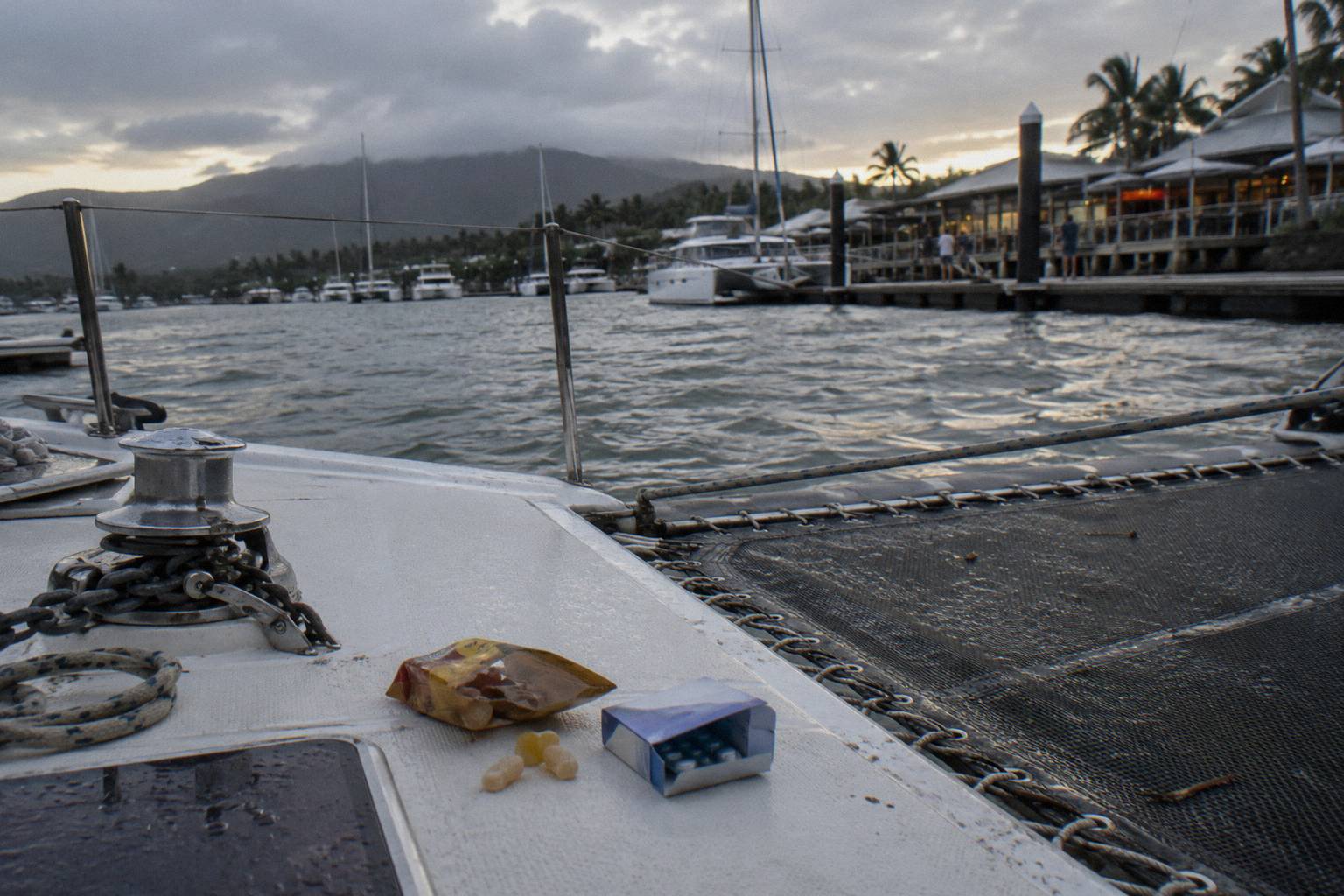
One more angle worth knowing: the same operator's sister vessel Shaolin offers that 10 percent discount for booking both trips, and the pairing of a mangrove evening and an open-water evening covers everything the inlet and the coast have to show. Beyond the evening boats, one adjacent daytime option exists: a Sailaway Low Isles afternoon snorkel trip of about 5.5 hours, from A$329, that sails home at sunset, though it is a reef day out rather than an evening cruise and is not suitable for non-swimmers. For dusk on the water with crocodiles in it, the river cruise stands alone.
Common Questions About Crocodile Cruises In Port Douglas
Will I Definitely See A Crocodile On An Evening Cruise?
No. The Lady Douglas operator says crocodiles are normally seen on over 90 percent of its trips, especially from May to November, but that is an operator claim, not a guarantee. Crocodiles can stay underwater and out of sight for hours, and no waterway in their range is crocodile free, which cuts both ways when it comes to spotting one.
Which Cruise Goes Where Crocodiles Live?
The Lady Douglas sunset cruise, 4:30pm to 6:00pm from A$48, travels several kilometres up the mangrove channels of Dickson Inlet to the inlet entrance, with commentary on mangroves, crocodiles and local history. The open-water sails out of the same marina do not run a crocodile route.
Is A Crocodile Cruise Safe For Children?
Lady Douglas takes all ages, with infant seats, infants on laps, colouring sheets, covered seating and a toilet on board. Sailaway also takes all ages but allows no prams or strollers. Shaolin suits children 4 and up best, and Indigo sets a minimum age of 10 on scheduled trips.
When Is The Best Time Of Year For Crocodile Spotting?
The operator points to the dry season, May to November, as when sightings are most frequent. Bureau of Meteorology data shows July to September as the driest months, averaging 23 to 32 mm of rain, while January to March each average over 395 mm.
How Much Does An Evening Crocodile Cruise Cost?
The Lady Douglas cruise costs from A$48 per person in Australian dollars, including one complimentary beverage and a snack box, with free cancellation up to 24 hours before the start. The open-water alternatives run from A$71 on the Shaolin junk and from A$105 on the Sailaway catamaran.
Is It Safe To Swim Or Paddle In Dickson Inlet?
No. Dickson Inlet is never described as safe to swim or paddle. Queensland Government advice says estuarine crocodiles can be found in any waterways and the sea throughout the range, that no waterway in their range is crocodile free, and that kayaks and paddleboards should be avoided in crocodile habitat.